Today’s installment of a remarkably specific list covers plot lines from popular fiction in which a major character’s imminent demise is foreshadowed by problems with their hands.
Albus Percival Wulfric Brian Dumbledore
The sixth novel in the Harry Potter series, The Half Blood Prince, begins with Dumbledore coming to visit Harry on Pivet Drive. Harry notices Dumbledore’s hand is blackened and dead-looking. He asks about it almost immediately, but Dumbledore shrugs it off, saying “I have no time to explain now. It is a thrilling tale, I wish to do it justice.” Harry asks Dumbledore several more times throughout the book, but each time he is rebuffed.
At the end of the novel, it is still a mystery. Well, sort of. The biggest mystery at the end of the book is the one of Snape’s allegiance. J.K. Rowling very cleverly unravels the story to make it seem as though Snape is evil, and aligned with Voldemort.
But if this is true, then Dumbledore was wrong about him, and Dumbledore was almost never wrong, particularly when it came to wartime strategizing. So at the end of the Half Blood Prince, if you wanted to get to the bottom of the biggest mystery, all you needed to do was concoct a little thought experiment. If Snape was good, then the only reason he would ever kill Dumbledore would be on Dumbledore’s own orders.
But why would Dumbledore want to be killed? Only if he knew his own death was imminent. And do we have any indications that Dumbledore might be ill? The hand. Sure enough, near the end of the seventh and final book, it is revealed Dumbledore tried to wear Marvolo Gaunt’s ring, which was protected by a very powerful dark curse. The curse started at his hand and was spreading to the rest of the body when Snape was able to stop it. But a curse such as this one could never be completely stopped. Dumbledore would be dead within a year, but he would be killed in the manner in which he chooses.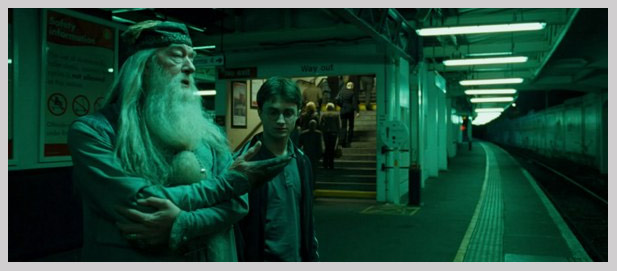
Marty McFly
“Pretty mediocre photographic fakery; they cut off your brother’s hair!”
This was Doc Brown’s comment after seeing Marty’s proof that he really was from 1985. It was a photo of all three McFly kids, and his sister was wearing a sweatshirt that said Class of ’84. Soon, they realize Marty’s Mom is in love with Marty, and it all becomes clear for the Doc. They look at the picture again, and Marty’s brother’s head is now missing. Erased… from existence.
The timer has started, and Marty needs to make his parents fall in love before his brother and sister are erased, because Marty himself will be next. It all comes to a head during the Enchantment Under the Sea Dance. Marty is playing guitar on stage when some jerk cuts into George and Lorraine’s dance (laughing maniacally, for some reason). Marty’s hand starts to fumble at his guitar, and when he looks at it, he sees it disappearing right in front of his eyes.
But of course George triumphantly returns, shoves that jerk to the floor, and kisses Lorraine. Marty pops up, having narrowly avoided his demise.
Interestingly, problems with the same hand also play a role in the plot of Back to the Future Part II. In the original version of 2015, we learn that Marty was always a sucker whenever someone called him “chicken”. He had been goaded into a drag race with Needles (played by Flea from the Red Hot Chili Peppers, incidentally), and had crashed into a Rolls Royce, thus ending any hope of a music career. Luckily, Marty learns his lesson in the old west, never races Needles, and presumably goes on to become a huge Rock N Roll star with a fully functioning right hand.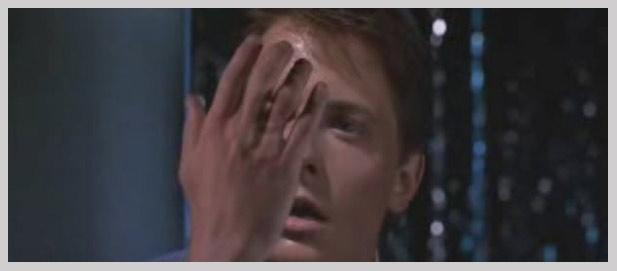
Roy Batty
Roy is a Nexus 6 Replicant in the film Blade Runner, which means he is an incredibly advanced robotic humanoid. It also means he was programmed to live only four years, in the hopes that he would be unable to develop complex emotions in such a short time period.
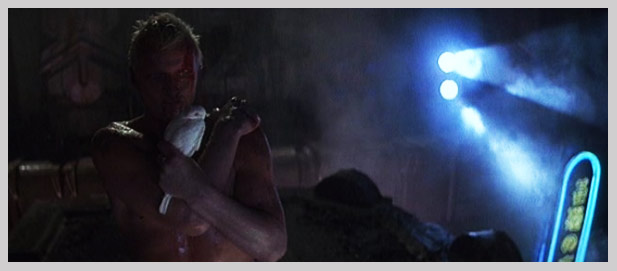
Roy is perhaps the most obvious entry in this list, because his bodily failure begins with his right hand. In an effort to regain control of his hand, he takes a nail and jabs it through his flesh like some kind of zombie Jesus. At this moment, the audience realizes Roy’s time is quickly running out. At first it seems his last goal in life is to kill Deckard, but once he realizes death is so near, Roy saves him instead.
Roy uses his final moments to wax poetically on life and death, saying “I’ve seen things you people wouldn’t believe: Attack ships on fire off the shoulder of Orion; I’ve watched C-beams glitter in the dark near the Tannhauser Gate. All those moments will be lost in time, like tears in rain. Time to die.”
Captain John H. Miller
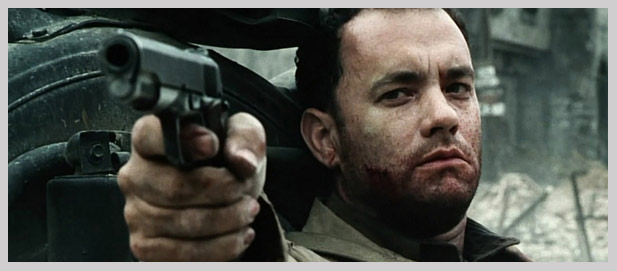
Tom Hanks’s hand shakes in the opening scenes of Saving Private Ryan because he is not an invincible war hero. He’s just a regular guy, a high school English teacher, thrust into war, trying to do the best job he can. He’s not John Wayne and he’s certainly not Superman.
He is, on the contrary, extraordinarily mortal. And this makes his character all the more heroic. This is also why the casting of Hanks is so perfect. Unlike Vin Diesel, who would use this film to propel himself into action stardom, Tom Hanks is the anti-action-star. He is the Jimmy Stewart everyman, and he makes us fellow non-action-stars ask ourselves: if we were in that position, could we do it?
Speaking of Diesel, Saving Private Ryan featured a huge number of actors in small parts who would later find much success on the big and small screens including: Nathan Fillion (Firefly), Bryan Cranston (Breaking Bad), Barry Pepper (True Grit), Jeremy Davies (Lost), Paul Giamatti (American Splendor), Ryan Hurst (Sons of Anarchy), not to mention established actors like Dennis Farina, Giovanni Ribisi, Matt Damon, Ed Burns, Tom Sizemore, and Ted Danson.
Ted Danson plays a character named Capt. Hamill, whose name, along with the line “I’ve got a bad feeling about this”, are references to films of Spielberg’s good friend George Lucas. These films lead us to the last character on this list…
Darth Vader
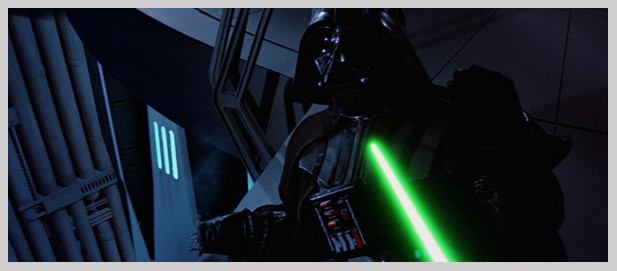
Although Vader loses his hand immediately before his demise, I’m including him on this list as an exception to the rule. The loss of his hand does not foreshadow or lead to his demise, but it does the opposite: it nearly saves his life.
The scene takes place in the final moments of Star Wars Episode VI: Return of the Jedi. Luke is trying not to engage his father in a light saber duel, but when Vader threatens Leia, Luke fights back with a fury. He slashes at a fallen Vader, cutting his hand off at the wrist. Vader is finally vulnerable, and it’s Luke’s chance to kill him.
But Luke looks at Vader’s stub of an arm and then he looks at his own mechanical hand. He had lost his cool, he had stooped to Vader’s level, and he was through fighting. Vader is spared due to the sympathy gained from a missing hand. Sure, he dies minutes later, but in that moment he is the anti-Dumbledore-McFly-Miller.
Update 1: October 18, 2012. I’d been looking forward to seeing Rian Johnson’s Looper ever since I first heard he was making it. Looper did not disappoint. There is an incredible scene which I will describe below (warning: spoilers), and it reminded me of a similar scene in the Dennis Quaid film Frequency. I realized I could add both films to this list, and then I realized something even better: three films on this list now involve time travel which means we have ourselves a SUBGENRE!
Seth
Loopers are assassins, killing people for a mafia that exists 30 years in the future, after time travel has been invented. The mafia sends victims back in time to be killed by loopers. Eventually, the mob closes the loop of a looper by sending him back in time to kill himself.
The flaw (obvious flaw, quite frankly) in this strategy is that the one person in the world least likely to murder a person is that person himself. Occasionally, a looper let’s himelf run free. But the mob has a rather brilliant solution.
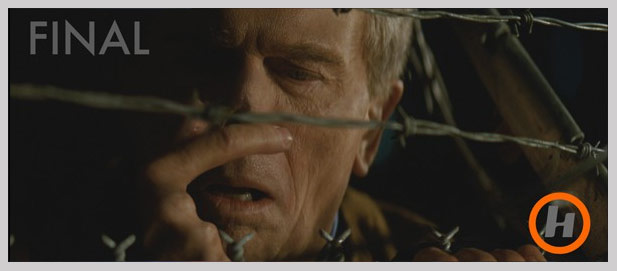
They kidnap the young looper. They carve a location into his arm. The old looper watches as the scar manifests on his skin. For a second, the old looper might be inclined to ignore it. But then he watches as a finger disappears. Then another one. Then his nose. He steals a car. He races to the location etched onto his arm, but as he gets there, he can’t stomp on the brakes because his foot is gone. Then his legs. Then his arms. Eventually, he is a living stump, and his last sight is a dark room, with a man on a table, kept alive by a doctor, completely wrapped in surgical gauze. It all started with a damaged hand. (Image credit to this awesome article on Looper’s FX.)
Jack Shepard
Watching the above scene in Looper I had two thoughts: 1) this is the most disgusting thing I have ever seen on film (somehow way grosser than any gross-out horror flick) and 2) I’ve seen this before!
But if you count both myself and Rian Johnson perhaps that just makes one of us. I’m guessing he never spun Frequency, starring Dennis Quaid and James Caveziel, on his DVD player.
The concept was the same. The execution was a little different. Both were awesome. In Frequency, a young father in 1970 and his grown-up son in 2000 are able to magically communicate via HAM radio (something about the northern lights). The son can tell the father things, and this can result in the future (or present) changing. The main thing the son wants to change is the death of his mother, who was murdered by a serial killer in late 1970. The father, a cop, goes on the chase and eventually finds the killer in his own home. In fact, the killer is in both of their homes – in 1970 and in 2000 – at the same time.
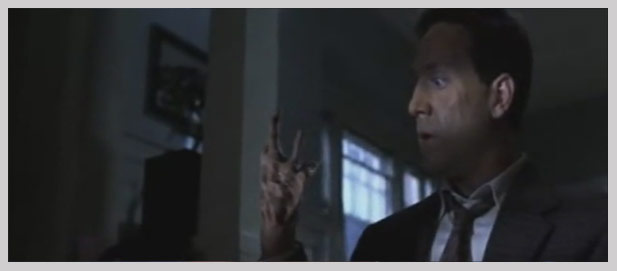
The HAM radio crackles with noise as both father and son wrestle with the same man. In 2000, the son is getting choked to death. But in 1970, the father is grabbing a shotgun and blowing the killer’s hand off. Now, this is a pretty exciting series of events for any action film, but these filmmakers took it to the next level by showing the killer, in the year 2000, watch in terror as his own hand withers into thin air. With Frequency, Looper, and Back to the Future, I believe we have the first “Hand Dies First” subgenre. I love it because “time travel films” is such a specific genre. Now I need to watch Raiders of the Lost Ark and a few other films to see if I can identify a “films of Steven Spielberg” subgenre.
Update 2: June 24, 2016. Let’ see, I last updated this post in October of 2012, back when I still watched movies. A lot has changed for me since then, mostly in the offspring department. I have two kids now! Which is great. But you know, some of your old hobbies just go by the wayside. I did get to finally catch Pixar’s “Inside Out”! And we get to add to this post!
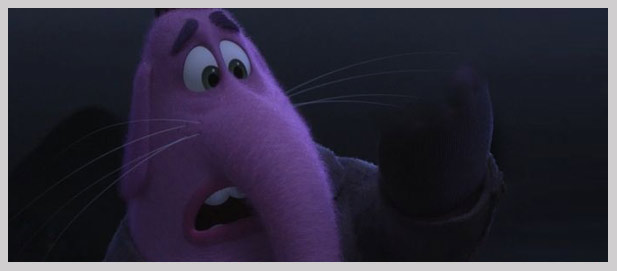
Bing Bong
When the Pixar people got around a table to discuss the handling of Bing Bong’s death (and the manner in which he disappears) I have to assume someone mentioned Marty McFly. It’s basically an homage. If you don’t remember, Bing Bong is the imaginary friend of Riley’s toddler years.
The filmmakers bravely thread a needle here. When Riley forgets things, they disappear. And it’s totally reasonable that the imaginary friend of a two year old would be forgotten. That’s life. It’s not painful, because we don’t remember it. But the moment is still poignant and sad and clever in all the right ways. The disappearance on Bing Bong begins, of course, with his hand.
Update 3: June 4, 2022. I last updated this post in 2016, back when I had two kids. Now I have four. I’m busy!
Miguel Rivera
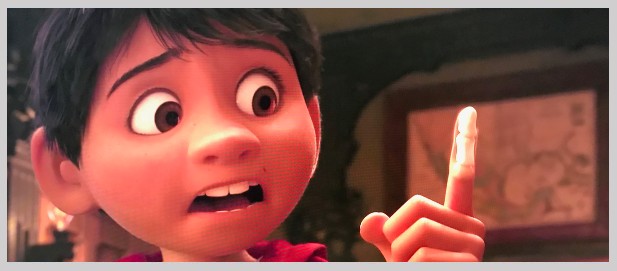
And look, I’ve returned with another Pixar example! Inside Out with Bing Bong (above) came out in 2015. Coco came out two years later in 2017.
I have many questions: were both screenwriters consciously doing an homage to Marty McFly? Was Coco written well before any Inside Out screenings? (I assume it was.) What did the Coco screenwriter think when they watched Bing Bong’s hand disappear? Did they think “Hey, I’m doing that bit too. It’s a great bit.”
Personally, I’m fine with it. Marty McFly deserves an homage in every film. In fact, I really hope this happens in another Pixar film soon. We already have a Time Travel Subgenre within this specific list. I’d love to add a Pixar Subgenre too, but I need at least three examples, right?